Key Takeaway: A salt-free water softener is more accurately called a water conditioner. Salt-free systems can help control mineral scale, but they do not remove the calcium and magnesium that make water hard. Salt-based softeners remove those hardness minerals through ion exchange. For Southwest Idaho homeowners, the better choice depends on the water’s measured hardness, the problems you want to solve, and your maintenance preferences.
A salt-free water softener sounds appealing: fewer salt bags, no salt refills, and a potentially simpler maintenance routine. But before choosing one for your Idaho home, it’s important to understand what salt-free technology actually does.
Salt-based water softeners and salt-free water conditioners address hard water differently. One removes hardness minerals. The other generally aims to reduce how those minerals form scale.
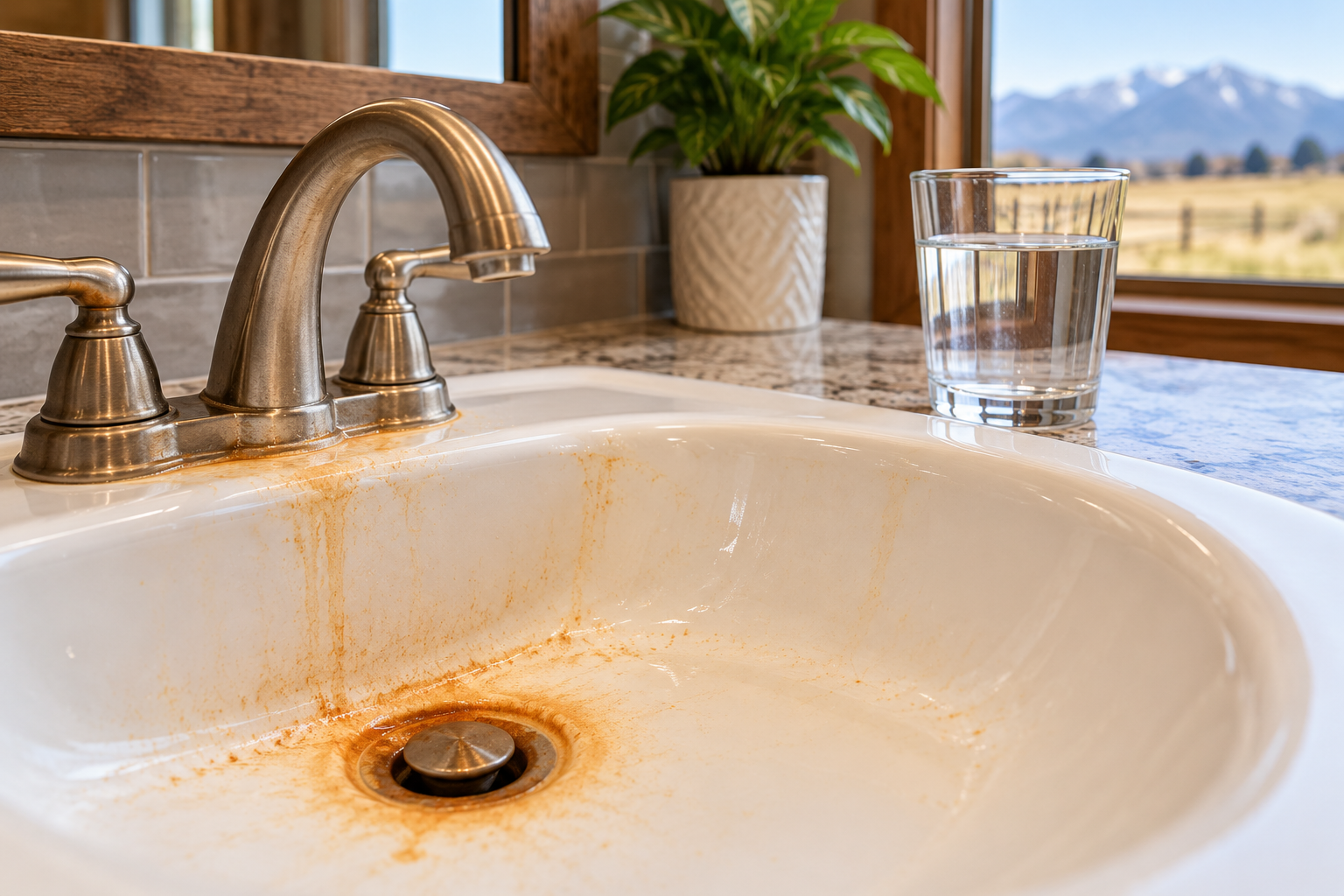
That distinction matters in Southwest Idaho, where homeowners frequently deal with mineral deposits, cloudy glassware, soap scum, and buildup around fixtures.
Here’s how the two technologies compare, what each can realistically accomplish, and how to determine which system makes sense for your home.
Quick Facts: Salt-Free vs. Salt-Based Systems
What Is the Difference Between a Water Conditioner and a Softener?
A water softener removes hardness minerals. A salt-free water conditioner generally does not.
Hardness comes primarily from dissolved calcium and magnesium. As these minerals move through household plumbing, they can contribute to scale deposits, soap scum, and spotting.
A traditional water softener uses ion exchange to reduce the concentration of calcium and magnesium. This changes the actual hardness measurement of the treated water.
Salt-free conditioning technology takes a different approach. Some systems use processes such as template-assisted crystallization (TAC) to influence how minerals form deposits. Rather than removing calcium and magnesium, they aim to make those minerals less likely to adhere as hard scale.
Because the minerals remain in the water, a salt-free conditioner generally won’t produce the same results as a conventional softener.
Salt-Free vs. Salt-Based Water Softeners: Side-by-Side Comparison
| Feature | Salt-Based Softener | Salt-Free Conditioner |
|---|---|---|
| Removes hardness minerals | Yes | No |
| Reduces measured water hardness | Yes | No |
| Helps control mineral scale | Yes | Potentially, depending on technology and water conditions |
| Improves soap performance affected by hardness | Yes | Not in the same way |
| Requires softener salt | Typically yes | No |
| Requires regeneration wastewater | Yes | Generally no for TAC-style conditioners |
Neither approach is automatically right for every household. The most useful question is whether you want to remove hardness minerals or primarily reduce scale formation.
How Does a Salt-Based Water Softener Work?
Salt-based water softeners use a process called ion exchange.
Inside the system, resin beads attract calcium and magnesium ions from incoming water. These hardness minerals are exchanged for sodium or, in some systems, potassium ions.
Over time, the resin reaches its treatment capacity. The system then regenerates using a brine solution to flush accumulated hardness minerals away and prepare the resin for continued use.
Benefits of Salt-Based Softening
- Reduces actual water hardness
- Helps prevent hardness-related scale accumulation
- Improves soap and detergent performance
- Reduces soap scum caused by hardness minerals
- Can make routine cleaning easier
For households dealing with persistent soap scum, mineral buildup, and poor cleaning performance, removing hardness minerals may provide a more complete solution than scale conditioning alone.
What About Salt and Water Consumption?
Salt-based softeners require salt and use water during regeneration. However, the amount consumed depends on equipment design, settings, household demand, and water hardness.
Modern demand-operated systems can regenerate according to water use rather than relying exclusively on a fixed schedule. This can help avoid unnecessary regeneration.
How Does a Salt-Free Water Softener Work?
Most products marketed as salt-free water softeners are better described as salt-free water conditioners.
One common technology, template-assisted crystallization, encourages hardness minerals to form microscopic crystals that are less likely to attach to surfaces as scale.
Unlike ion-exchange softening, this process does not remove calcium or magnesium from the water.
Potential Advantages of Salt-Free Conditioning
- No routine softener salt refills
- No conventional salt-based regeneration cycle
- Potential reduction in scale formation
- May suit households primarily concerned with scale control
- Can simplify some aspects of system maintenance
Performance depends on the particular technology, equipment specifications, and water chemistry. Not every product marketed as salt-free uses the same process or has the same supporting performance data.
Yes. Because salt-free conditioners do not remove calcium and magnesium, a conventional hardness test generally produces a similar result before and after treatment. That does not necessarily mean the conditioner is malfunctioning; it means the equipment is designed for a different purpose than mineral removal.
Which System Performs Better With Southwest Idaho’s Hard Water?
For homeowners who want measurable hardness reduction, salt-based softening is generally the more appropriate technology. A salt-free conditioner may be worth considering when scale reduction is the primary goal and the household accepts that hardness minerals will remain.
Water hardness varies across Southwest Idaho. Homes in Boise, Meridian, Nampa, Caldwell, Eagle, Kuna, and nearby communities do not necessarily receive water with identical mineral content.
Differences in municipal water supplies, groundwater sources, and private wells can all affect the hardness level reaching a particular home.
The U.S. Geological Survey classifies water hardness using these general ranges:
| Classification | Hardness (mg/L as CaCO3) | Approximate Grains per Gallon |
|---|---|---|
| Soft | 0–60 | 0–3.5 |
| Moderately hard | 61–120 | 3.6–7.0 |
| Hard | 121–180 | 7.1–10.5 |
| Very hard | Above 180 | Above 10.5 |
These are classification ranges, not measurements for any particular Idaho city or household.
For a home with very hard water and substantial soap scum or mineral deposits, a salt-based softener may be the more practical choice. For a home where the main concern is controlling scale without salt handling, a salt-free conditioner may be worth evaluating.
The actual hardness reading and the manufacturer’s treatment limitations should guide the decision.
What Should You Consider Before Choosing a System?
Instead of comparing systems by marketing claims alone, consider these five questions.
1. How Hard Is Your Water?
A hardness test provides a starting point for determining whether full softening is appropriate.
2. What Problems Are You Trying to Solve?
Scale buildup, soap scum, spotty dishes, and poor soap performance may point toward different priorities. Identify which improvements matter most.
3. Are You Comfortable Maintaining a Salt-Based System?
Salt-based equipment requires ongoing salt management and periodic service. Salt-free equipment avoids salt refills but is not necessarily maintenance-free.
4. Does Your Water Have Other Problems?
Iron, manganese, sediment, chlorine, and other water-quality concerns may require separate or additional treatment. Neither standard softening nor scale conditioning should be assumed to address every contaminant.
5. What Results Does the Equipment Actually Promise?
Ask whether the product removes hardness, reduces scale, or performs another treatment function. Review its documented performance and limitations.
A salt-free conditioner may help reduce scale while leaving hardness minerals in your water. If your main goals are less soap scum, improved detergent performance, and genuinely softer water, make sure the system you’re considering is designed to deliver those results.
Are Salt-Free Systems Worth the Investment?
They can be, depending on the homeowner’s goals.
A salt-free conditioner may be a reasonable investment for someone who prioritizes scale management and wants to avoid purchasing and handling softener salt.
But if the household expects softer-feeling water, reduced soap consumption, and lower measured hardness, a conditioner may not meet those expectations.
Likewise, a salt-based softener may be a better fit for significant hardness problems, even though it requires salt and regeneration.
Long-term cost comparisons should consider more than the purchase price. Installation, maintenance, media replacement, salt consumption, regeneration water, and equipment lifespan can all affect ownership costs.
There is no universal winner without knowing the water conditions and the household’s priorities.
Before requesting a quote, write down your three biggest water complaints. A professional can use those priorities alongside your water test results to explain what each system can realistically improve.
Local Water Treatment Expertise for Southwest Idaho
Kinetico of SW Idaho serves homeowners throughout the Treasure Valley and surrounding communities, including Boise, Meridian, Nampa, Caldwell, Eagle, Kuna, Star, Middleton, and other nearby areas.
As a locally owned and operated authorized Kinetico dealer, the company offers water testing and treatment options designed around the needs of individual homes.
Its product lineup includes traditional water softeners as well as salt-free water systems, allowing homeowners to explore different approaches rather than assuming every property needs the same equipment.
Because local water conditions vary, testing provides a more reliable starting point than selecting a system based only on city or ZIP code.
Not Sure Which Water Treatment System Fits Your Home?
A water test can help you understand your hardness level and compare salt-based softening with salt-free conditioning based on your actual water conditions.
Talk to an expert about the right system for your home.
Frequently Asked Questions About Salt-Free and Salt-Based Water Softeners
Does a salt-free water softener actually soften water?
No. Most salt-free conditioners do not remove calcium and magnesium, so they do not reduce measured water hardness. Their primary purpose is typically scale control.
Will a salt-free conditioner prevent hard water spots?
It may reduce certain scale deposits, but it does not eliminate hardness minerals. Spots or mineral residue can still appear when water evaporates from dishes, glass, or fixtures.
Do salt-based water softeners add salt to drinking water?
Conventional sodium-based softeners exchange calcium and magnesium for sodium ions. Properly operating systems do not normally deliver regeneration brine into household water. The amount of sodium added depends on the original hardness level.
Are salt-free water conditioners maintenance-free?
No. Although many salt-free systems do not require salt refills or regeneration, they may need media replacement, prefilter changes, inspections, or other maintenance specified by the manufacturer.
Which type of system is better for very hard water?
A salt-based ion-exchange softener is generally the more direct solution when the goal is to remove substantial hardness. Salt-free conditioners may offer scale-control benefits, but performance depends on the product and water chemistry.
Can a water conditioner remove iron or other contaminants?
Not necessarily. A conditioner designed for scale control should not be assumed to remove iron, bacteria, arsenic, or other contaminants. Additional treatment may be required based on water testing.
Choose the System That Solves Your Actual Water Problem
If you want genuinely softened water and relief from the everyday effects of hardness, a salt-based water softener may be the better fit.
If your main concern is reducing mineral scale without handling salt, a salt-free conditioner may be worth considering.
Either way, the decision should begin with a water test, realistic expectations, and an understanding of what the equipment is designed to do.
Kinetico of SW Idaho can help you compare your options and understand which approach makes sense for your home’s water conditions.
Talk to an expert about the right system for your home and make your decision with confidence.